Understanding Your Child’s Anxiety & When to Seek Help

When Does a Child’s Anxiety Warrant Seeing a Psychologist?
Anxiety is a normal and even helpful emotion for all of us. For kids, it can often show up as hesitation in new situations, worry about performance, physical symptoms, or a need for reassurance during transitions. In many cases, these experiences are temporary and developmentally appropriate.
However, there are times when anxiety begins to feel bigger, more persistent, and harder for a child (and their family) to manage. At LittleKind Psychology, our child psychologists specialize in working with kids and families in Calgary who are struggling with anxiety. Understanding when anxiety has crossed over into something more significant can help parents decide when additional support may be helpful.
When Anxiety Becomes Clinically Significant
As a general guideline, child psychologists look at three key factors:
Intensity- Are the worries or fears stronger than expected for the child’s age?
Frequency and duration- Do they occur often and persist over weeks or months?
Impact on functioning- Are they interfering with daily life (school, friendships, sleep, family routines)?
When anxiety is persistent, intense, and begins to significantly limit a child’s ability to participate in everyday activities, it may be time to seek some additional support.
What Different Types of Anxiety Can Look Like
Generalized Anxiety
Children with more generalized anxiety tend to worry about many different things, often simultaneously. These worries can feel difficult to control and may span a variety of topics or areas of focus.
Common signs include:
Excessive worry about school, health, family, or the future
Frequent reassurance-seeking
Perfectionism or fear of making mistakes
Physical symptoms (e.g., stomachaches, headaches)
Difficulty relaxing or “turning off” their thoughts
These children often report having physical symptoms of anxiety and may be described as “always on edge” or “worry warts”.
Separation Anxiety
Separation anxiety is developmentally typical for many children, but it becomes more concerning when it is intense, prolonged, or interferes with independence.
Signs may include:
Extreme distress when separating from caregivers
Difficulty attending school or activities independently
Persistent worry about something bad happening to a parent
Trouble sleeping alone
When separation anxiety limits a child’s ability to engage in age-appropriate activities or attend school, seeking professional support can be helpful.
Social Anxiety
Social anxiety goes beyond shyness. It often involves a significant fear of being judged, embarrassed, or evaluated negatively by others.
Children may:
Avoid speaking in class or participating in groups
Struggle to initiate or maintain friendships
Become very quiet or “freeze” in social settings
Experience intense fear before social events
Rehearse or overthink interactions
These children are often deeply aware of social expectations but feel overwhelmed by them.
Obsessive-Compulsive Symptoms (OCD)
OCD involves a cycle of intrusive thoughts (obsessions) and/or repetitive behaviours or mental acts (compulsions) that a child feels driven to perform to reduce anxiety.
Examples include:
Repeated handwashing, checking, or cleaning
Needing things to feel “just right”
Intrusive thoughts about harm, contamination, or mistakes
Excessive reassurance-seeking
Distress when unable to complete rituals
A key feature of OCD is that the behaviours are time-consuming and difficult for the child to control, often interfering with their daily life. However, OCD can be treated effectively in kids with the support of a trained child psychologist.
When to Consider Seeking Help
It may be helpful to consult a child psychologist if:
Anxiety is getting in the way of school, friendships, or family life
Your child is avoiding important activities
Reassurance and support at home don’t seem to be enough
Symptoms are persisting or worsening over time
You feel unsure how to respond or support your child
How Is Anxiety Treated in Children?
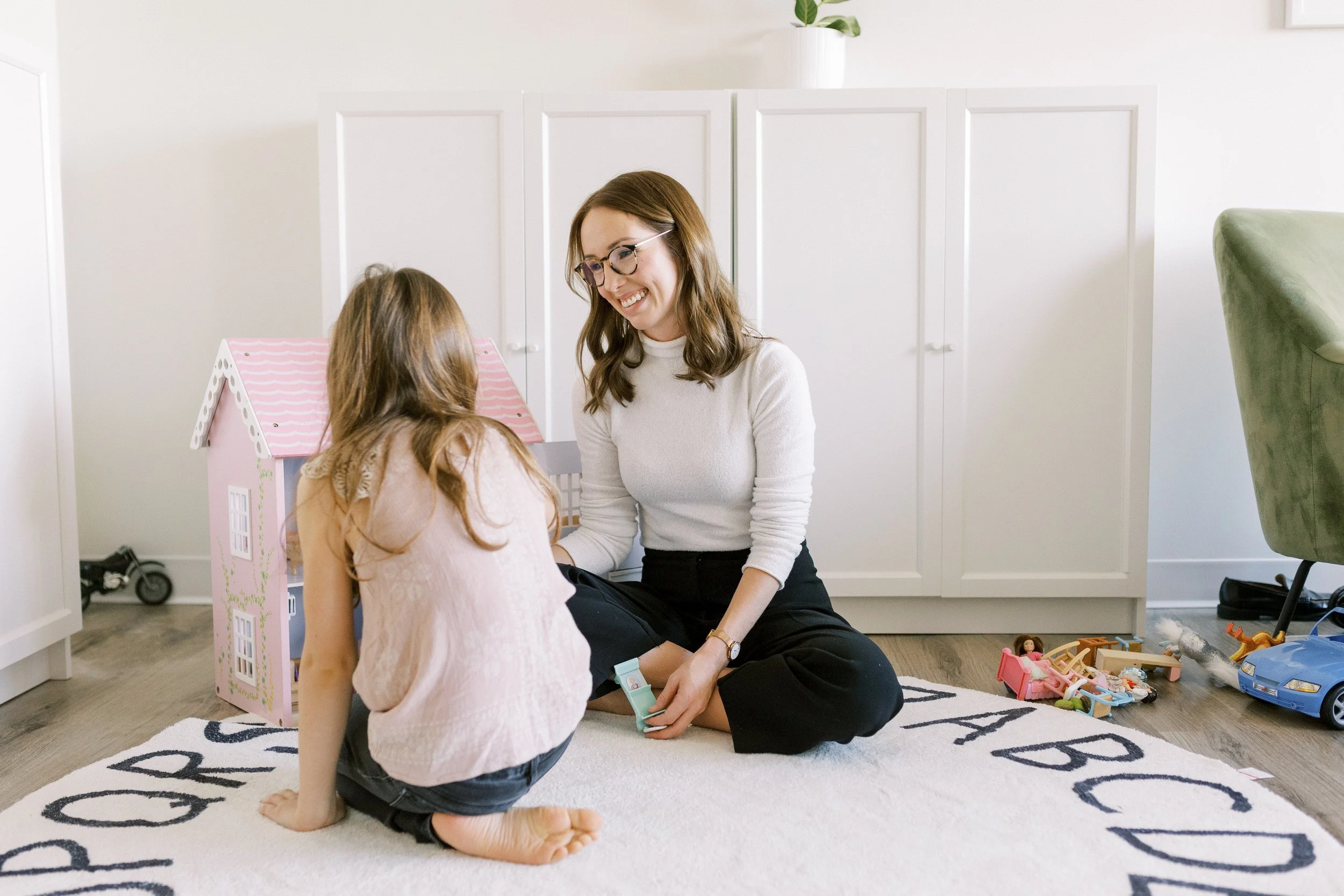
Effective treatment for child anxiety is not one-size-fits-all. At LittleKind Psychology, we tailor our approach to the developmental level and needs of every child we see, often using play therapy, CBT, ACT, and ERP approaches that emphasize parental involvement. Research has consistently shown that interventions are most effective when they involve both the child and their caregivers.
Play-Based and Developmentally Sensitive Approaches
For younger children especially, therapy often happens through play and relationship-based approaches. Rather than expecting children to talk directly about their worries, we use play to:
Help children express emotions safely
Build emotional awareness and regulation skills
Gradually face fears in a supported way
Strengthen their sense of competence and confidence
Play provides a natural language for children to process experiences that may feel overwhelming.
Cognitive Behavioural Therapy (CBT) and Acceptance and Commitment Therapy (ACT)
In addition to play-based approaches, many evidence-based treatments for child anxiety draw from Cognitive Behavioural Therapy (CBT) and Acceptance and Commitment Therapy (ACT).
Cognitive Behavioural Therapy (CBT) helps children understand the connection between their thoughts, feelings, and behaviours. In therapy, children learn to:
Recognize anxious thoughts (e.g., “Something bad will happen”)
Evaluate whether those thoughts are helpful or accurate
Gradually face feared situations instead of avoiding them
Build coping skills to manage physical symptoms of anxiety
CBT is one of the most well-researched treatments for childhood anxiety and is often a first-line approach in addition ot being integrated into other interventions.
Acceptance and Commitment Therapy (ACT) takes a slightly different perspective. Rather than trying to change or challenge anxious thoughts, ACT helps children:
Notice and make space for uncomfortable thoughts and feelings
Reduce the struggle against anxiety
Focus on what matters to them (e.g., friendships, learning, trying new things)
Take small, meaningful steps toward those values, even when anxiety is present
ACT can be especially helpful for children who feel stuck trying to “get rid of” their anxiety, shifting the focus toward building flexibility and resilience.
At LittleKind Psychology, our child psychologists integrate elements of CBT and ACT with play-based and relational approaches, tailoring strategies to the child’s developmental level and individual needs.
Exposure and Response Prevention (ERP) for OCD
For children experiencing OCD, Exposure and Response Prevention (ERP) is considered the gold-standard treatment.
ERP involves:
Gradual exposure to feared thoughts or situations
Resisting compulsions (the behaviours used to reduce anxiety)
Learning that anxiety decreases on its own over time
For example, a child who fears contamination might gradually practice touching objects without washing immediately afterward, with reinforcement, support and pacing that meets them where they are.
Importantly, ERP is done in a collaborative, supportive, and step-by-step way, helping children build confidence while reducing the hold OCD has on their daily life.

Working with Parents
Parents are a central part of treatment. Research consistently shows that supporting parents is one of the most effective ways to support anxious children.
This may include:
Understanding the function of anxiety and behaviour
Learning how to respond effectively to reassurance-seeking
Supporting gradual exposure to feared situations
Reducing accommodations that unintentionally maintain anxiety
Building connection and emotional safety
Often, small shifts in how parents respond can lead to meaningful changes for the child.
Anxiety can be a normal and healthy part of our lives. However, when children struggle with anxiety in ways that start to impact their daily functioning, it could be a good time to seek professional guidance. A consultation with a child psychologist can help you better understand what you’re seeing and how to support your child moving forward. At LittleKind Psychology, our child psychologists specialize in supporting kids and families who are struggling with anxiety. Reach out today for a free initial consultation, we’d love to hear from you!